
Key Highlights
- Outdoor play strengthens language acquisition in bilingual settings through natural, context-rich interactions.
- Physical activities outdoors support multiple developmental domains outlined in comprehensive child development curriculum frameworks.
- Nature-based learning environments enhance cognitive flexibility and problem-solving abilities.
- Structured outdoor programmes align with the nursery curriculum in Singapore standards, whilst promoting cultural awareness.
Introduction
The connection between outdoor play and cognitive development has transformed how educational institutions approach early learning. Bilingual preschools across Singapore have recognised that playgrounds and garden spaces serve purposes far beyond simple recreation. These environments become dynamic classrooms where children absorb two languages simultaneously whilst developing motor skills, social awareness, and environmental consciousness.
Research consistently demonstrates that young minds thrive when learning extends beyond four walls. For families considering a Chinese preschool or any bilingual programme, understanding how outdoor activities complement structured lesson plans becomes essential in making informed decisions about early education.
1. Language Immersion Through Natural Contexts
Children learning Mandarin and English simultaneously benefit tremendously from outdoor settings that provide authentic contexts for vocabulary building. When educators guide nature walks, they create opportunities for spontaneous language switching that mirrors real-world bilingual communication. A child examining insects might hear “butterfly” and “蝴蝶” used interchangeably, cementing both terms through direct sensory experience rather than rote memorisation.
These unscripted moments prove more effective than flashcards because emotional engagement amplifies retention. A well-designed child development curriculum incorporates such experiences systematically, ensuring outdoor time serves specific linguistic goals whilst appearing entirely playful to participants. Teachers might structure scavenger hunts requiring children to identify objects using vocabulary from both languages, turning gardens into immersive learning laboratories.
The nursery curriculum in Singapore increasingly emphasises such integrated approaches, recognising that language acquisition accelerates when children associate words with actions, textures, and discoveries. Climbing frames become venues for learning directional vocabulary, whilst sandpits facilitate conversations about quantities and comparisons across two linguistic systems.
2. Physical Development Meets Cognitive Growth
Outdoor play equipment challenges children’s gross motor skills in ways that directly support brain development. Neuroscience reveals that physical movement strengthens neural pathways responsible for problem-solving and memory formation. When bilingual programmes incorporate obstacle courses, balancing activities, and coordinated group games, they’re simultaneously building physical competence and cognitive architecture.
A robust child development curriculum acknowledges these interconnections explicitly. Educators might design activities where children must follow multi-step instructions in Mandarin to complete a physical challenge, then explain their strategy in English afterwards. This layered approach exercises working memory, language switching abilities, and physical coordination within single activities.
Traditional playgrounds often separate physical education from academic learning, but contemporary nursery curriculum in Singapore frameworks reject this artificial division. Climbing challenges become mathematics lessons involving spatial reasoning. Group sports introduce conflict resolution and negotiation skills practised in both languages. Even simple activities like watering plants create opportunities to discuss life cycles, responsibility, and seasonal changes using bilingual vocabulary.
3. Cultural Learning Through Environmental Engagement
Gardens and outdoor spaces offer unique platforms for transmitting cultural knowledge that purely classroom-based instruction cannot replicate. Chinese nursery preschool programmes frequently incorporate traditional activities like growing vegetables used in local cuisine or celebrating seasonal festivals outdoors. These experiences ground abstract cultural concepts in tangible, memorable experiences.
Children might participate in planting exercises timed with traditional agricultural calendars, learning both the scientific processes and cultural significance simultaneously. Such activities fulfil multiple objectives within a comprehensive child development curriculum, addressing cognitive, social, cultural, and physical developmental domains concurrently.
The nursery preschool curriculum in Singapore benefits from the nation’s multicultural context, and outdoor spaces become neutral zones where various traditions can coexist and intermingle. A well-designed programme might rotate through different cultural perspectives on nature, seasonal celebrations, and environmental stewardship, with each explored through both English and Mandarin frameworks.
4. Social-Emotional Development in Unstructured Settings
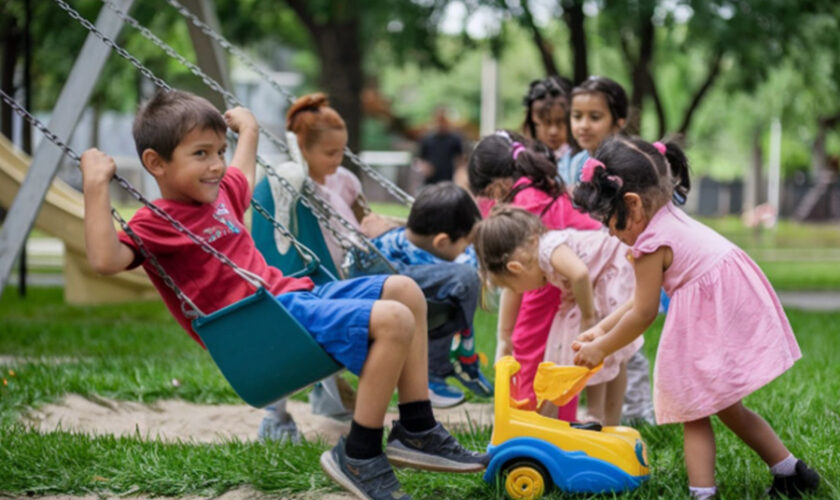
Perhaps outdoor play’s most valuable contribution comes through unstructured social interaction. When children negotiate playground rules, resolve disputes over equipment, or collaborate on imaginative projects, they develop emotional intelligence that formal lessons struggle to teach. Bilingual settings amplify these benefits because children must navigate social dynamics whilst managing two language systems.
Educators observe these interactions carefully, intervening strategically to extend learning moments. A child development curriculum that prioritises social-emotional growth recognises outdoor free play as essential rather than supplementary. Teachers might notice children defaulting to one language during conflicts and gently encourage them to express feelings in both languages, building emotional vocabulary across linguistic systems.
The current nursery curriculum in Singapore emphasises holistic development, and outdoor environments naturally support this goal. Children learn risk assessment whilst climbing, persistence when mastering new physical skills, and empathy when comforting peers who’ve experienced minor setbacks. These lessons occur organically within contexts that feel like pure play, making them deeply internalised rather than superficially memorised.
Conclusion
Outdoor play represents far more than a break from academic instruction within quality bilingual early childhood programmes. These experiences form the foundation upon which language skills, physical capabilities, cultural awareness, and social competencies develop simultaneously. Educational approaches that integrate outdoor learning with structured curricula prepare children for both academic success and life beyond classroom walls.
Ready to see how outdoor learning transforms early education? Visit Orange Tree Preschool and experience firsthand how our bilingual programme uses nature as a classroom.