


close

October 2026

Education

Balancing Professional Development With Flexible Full-Time and Part-Time Accounting Studies

Balancing Professional Development With Flexible Full Time and Part Time Accounting Studies

Navigating modern career paths requires continuous learning while managing daily job responsibilities effectively. Acquiring essential accounting skills allows professionals to handle corporate financial records with precision. Studying on a custom schedule helps individuals upgrade their qualifications without quitting current jobs. Working adults gain immense value when they balance higher education alongside real work tasks. Professionals aiming to advance their accounting careers can explore mpa singapore programs to strengthen their qualifications and expand future career opportunities.

Strategic Schedule Planning Methods

Creating a structured timetable remains essential for working students managing tight daily routines. Allocating specific hours for study guarantees steady progress throughout the academic term. Employers often support staff members who show dedication toward improving personal capability. Setting clear boundaries prevents burnout while keeping focus sharp during complex tasks. Students handle assignments smoothly when they maintain regular learning habits each week.

Selecting Suitable Academic Options

Choosing between different course formats depends entirely on individual capacity and goals. Flexible enrollment options permit learners to adjust workload according to personal demands. Coursework tailored for working adults delivers practical knowledge relevant to current market needs. Selecting appropriate academic paths ensures smooth progress toward desired credentials.

  • Structured modules help busy working individuals manage study schedules easily.
  • Online resources provide convenient learning access from any location daily.
  • Interactive sessions foster strong collaboration among adult classroom peers worldwide.
  • Continuous evaluation methods track learner progress across complex business subjects.
  • Flexible timelines allow students to balance family life and study.

Optimizing Personal Time Allocation

Managing daily commitments requires careful focus on essential personal and academic priorities. Dividing large study targets into smaller actions makes workload feel very manageable. Professionals should utilize quiet morning hours to complete demanding reading assignments easily.

Proper rest keeps the mind sharp for evaluating complex numerical reports accurately. Establishing regular study routines prevents last-minute preparation pressure during exam periods. Strong organization skills ultimately lead to higher academic success and career growth.

Enhancing Practical Knowledge Application

Applying new theoretical concepts directly at work accelerates overall professional development greatly. Working learners quickly recognize how classroom theories solve actual financial workplace challenges. Daily tasks become excellent opportunities to practice advanced technical techniques and formulas. Sharing fresh knowledge with colleagues improves team efficiency and overall project outcomes.

  • Practical case studies help students understand complex corporate financial scenarios.
  • Hands-on assignments build strong confidence for solving real workplace problems.
  • Professional mentorship guides working learners through difficult academic course topics.
  • Peer discussions encourage knowledge sharing among students from diverse industries.
  • Specialized training modules prepare graduates for advanced roles inside organizations.

Expanding Workplace Growth Potential

Earning higher credentials opens diverse opportunities across various global financial sectors. Master’s-level qualifications like mpa singapore enhance professional credibility among potential employers. Advanced knowledge enables individuals to take on leadership roles within corporate organizations.

Continuous learning ensures workers stay relevant despite changing industry standards and expectations. Qualified specialists gain higher confidence when navigating complex financial regulations and requirements. Broadened expertise opens doors to exciting career advancements and higher compensation.

Building Sustainable Study Routines

Establishing consistent habits allows adult learners to balance demanding work projects and coursework. Creating designated study spaces minimizes surrounding distractions during intensive evening reading sessions. Open communication with supervisors helps align work schedules during heavy examination weeks.

Regular review sessions keep core concepts fresh without creating unnecessary last-minute stress. Maintaining physical well-being provides steady energy needed for managing combined commitments. Developing balanced daily habits secures steady academic advancement while excelling professionally.

FAQ

Is flexible learning suitable for working accounting professionals daily?

Flexible study options allow working individuals to manage schedules easily.

How do students balance job tasks with academic deadlines?

Proper time management helps learners complete course assignments without stress.

Does higher education help improve long-term career growth?

Earning advanced qualifications opens new doors for professional workplace promotion.
read more
Education

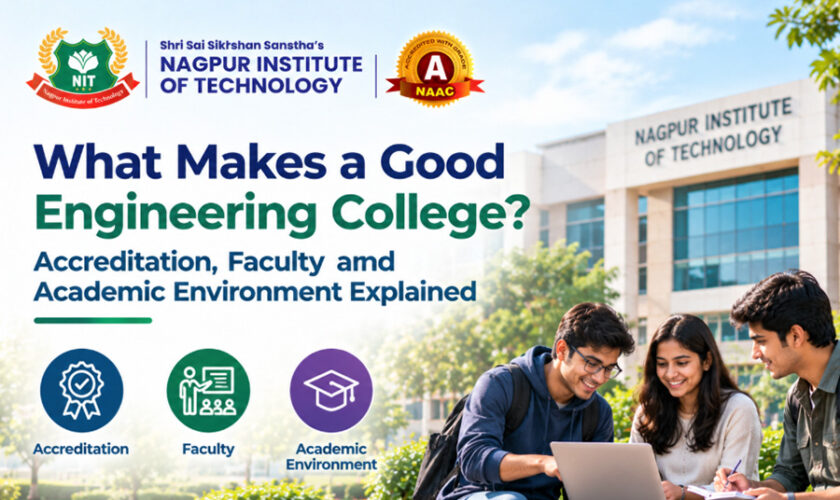
What Makes a Good Engineering College? Accreditation, Faculty and Academic Environment Explained

What Makes a Good Engineering College Accreditation Faculty and Academic Environment Explained

A good engineering college is not defined by one ranking, one building or one placement advertisement. Students need to examine several systems that work together: approval, academic quality, faculty access, laboratories, assessment, student support, research, industry exposure and graduate outcomes. If one of these systems is weak, the effect often appears later, when students start projects, internships or placement preparation.

The National Institutional Ranking Framework offers a useful way to think about college quality. It evaluates institutions across broad areas such as teaching and learning resources, research and professional practice, graduation outcomes, outreach and inclusivity, and perception. Students do not need to calculate a NIRF score, but they can borrow the logic: use multiple kinds of evidence.

Approval and accreditation answer different questions

Students searching for a NAAC accredited engineering college in Nagpur should first understand the terms. Regulatory approval confirms that an institution or programme is permitted to operate under the applicable technical-education framework. Affiliation or university status determines the academic and examination relationship. Accreditation is a quality-assurance process that examines institutional or programme-level practices against defined criteria.

These terms should not be treated as interchangeable. During admission, ask for the current approval and affiliation position first. Then check accreditation status and validity from the relevant official source. Old certificates on a website should not be accepted without checking dates.

Faculty quality is more than the number of names on a page

A faculty list tells you who is associated with the department. It does not tell you how accessible they are to students. During a campus visit, ask how tutorials, mentoring, doubt-solving and project supervision work. Speak to current students if possible.

Faculty continuity matters because engineering subjects build over semesters. A department with constant turnover can struggle to maintain laboratories, projects and academic planning. Qualifications and experience are useful indicators, but student interaction is the practical test.

Ask a specific question: “If I do not understand a core subject after class, what is the normal way to get help?” The answer reveals more than a generic claim about experienced faculty.

Academic environment can be seen in ordinary routines

A strong engineering college in Nagpur should be judged on what happens on a normal Tuesday, not only during an open house. Are classes conducted regularly? Do students use laboratories? Are internal assessments returned with feedback? Are technical activities visible? Is the library being used? Do notice boards and online systems carry current academic information?

Discipline and support need balance. Attendance rules matter in professional education, but students also need a system for genuine medical or academic difficulties. Ask how mentoring, grievance handling and first-year adjustment are managed.

Laboratories should prove that theory becomes practice

Engineering is applied learning. In a good laboratory, students do not merely watch an instructor perform an experiment. They handle equipment, take readings, compare results, make errors, repeat work and explain what happened.

The test is easy to apply. During a visit, ask a third-year student to describe the most recent practical or project. A detailed answer usually tells you more about the learning culture than a list of laboratory names.

For computing departments, practical exposure includes programming, systems, databases, networks and project development. For core branches, it may include machines, measurements, surveying, materials, manufacturing, thermal systems or power equipment. The equipment should match the curriculum and be used regularly.

Research matters even for undergraduate students

Research does not mean every B.Tech student must publish a paper. It means the college encourages students to ask questions, measure results, test ideas and document what they learned. A project that fails for a clear technical reason can be educational if the student understands the failure.

NIRF includes research and professional practice as a major parameter because a higher-education institution should contribute more than classroom delivery. Students can check whether departments have active projects, patents, publications, funded work, technical competitions or industry-supported problems. Claims should be current and verifiable.

Graduation outcomes need context

Placements are one outcome, but not the only one. Higher studies, entrepreneurship, competitive examinations and professional qualifications may also be valid paths. A college should provide enough academic and career support for students to pursue different routes.

If placement data is presented, ask for recent batch-wise figures, role types and eligibility conditions. Do not assume the highest package represents the typical student.

The decision should be evidence-based

Before paying an admission fee, students should be able to answer these questions: Is the programme approved for the current year? Is affiliation clear? Is accreditation current where claimed? Are faculty members available beyond lectures? Are laboratories active? Does the department support projects and internships? Are fees and rules transparent? Are graduate outcomes reported with enough context to support a fair comparison?

Compare the same evidence across two or three colleges: current approvals, faculty, laboratory access and recent outcomes. Side-by-side notes make gaps easier to notice.

A college does not need to be perfect on every measure. It does need to be clear about what it offers and consistent in delivering the basics. The best evidence is not a slogan. It is a pattern of current documents, functioning facilities, informed faculty, active students and transparent answers.

read more